“Make Women Farmers Drivers of Agricultural Interventions”: SWEDIWorld in Vanguard

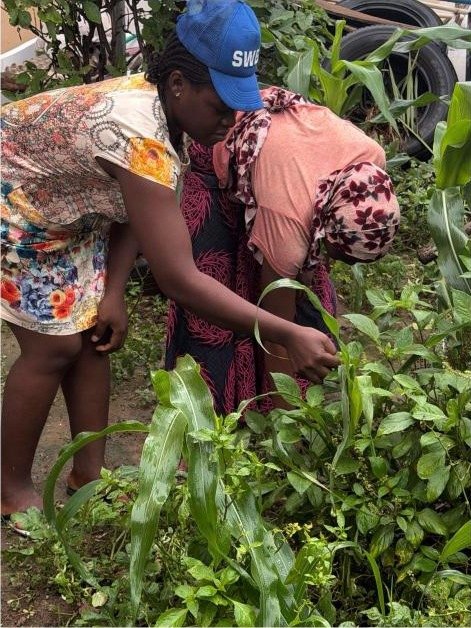
On 21 October 2026, Vanguard reported a call by stakeholders for governments at all levels to make women farmers active drivers of agricultural interventions, not merely beneficiaries, as one way of closing Nigeria’s food gap. SWEDIWorld’s Founder and Executive Director, Sewuese Asa, was among those who spoke.

What SWEDIWorld said

Describing the exclusion of women farmers as an obstacle to food security, Sewuese Asa said that “Nigeria cannot close its food gap while leaving women farmers at the margins of agricultural interventions”. She stressed that “this is not a gap in ability. It is a gap in access”, and identified four major constraints:

  • limited land ownership,
  • inadequate inputs,
  • weak extension services, and
  • underrepresentation in agricultural leadership.

She urged governments to implement the revised National Gender Policy on Agrifood Systems, with clear targets and adequate funding.

Sharing the feature on LinkedIn, she added: “We cannot talk about food security without addressing the inequalities that limit women’s access to land, finance, agricultural inputs, technology and decision-making opportunities. Women farmers are already contributing to food production and sustaining households. What they need is fair access to resources, meaningful representation and agricultural policies that recognise their contribution.”

The wider conversation

Other stakeholders quoted in the report included the All Farmers Association of Nigeria, DeBranch Farmers Limited, JetFarms and D’More Food & Spices, and ActionAid Nigeria, who called for interventions that reach women at scale, measure economic outcomes, and expand access to irrigation, mechanisation, storage, processing, land and finance.

Read the full report on the Vanguard website: “Make women farmers drivers of agric interventions to close food gap — Stakeholders” (Vanguard, 21 October 2026, also in the AgroBiz section, page 10 of the print edition).
International Day of the Girl Child 2026: Her Voice. Her Future. Her Planet.

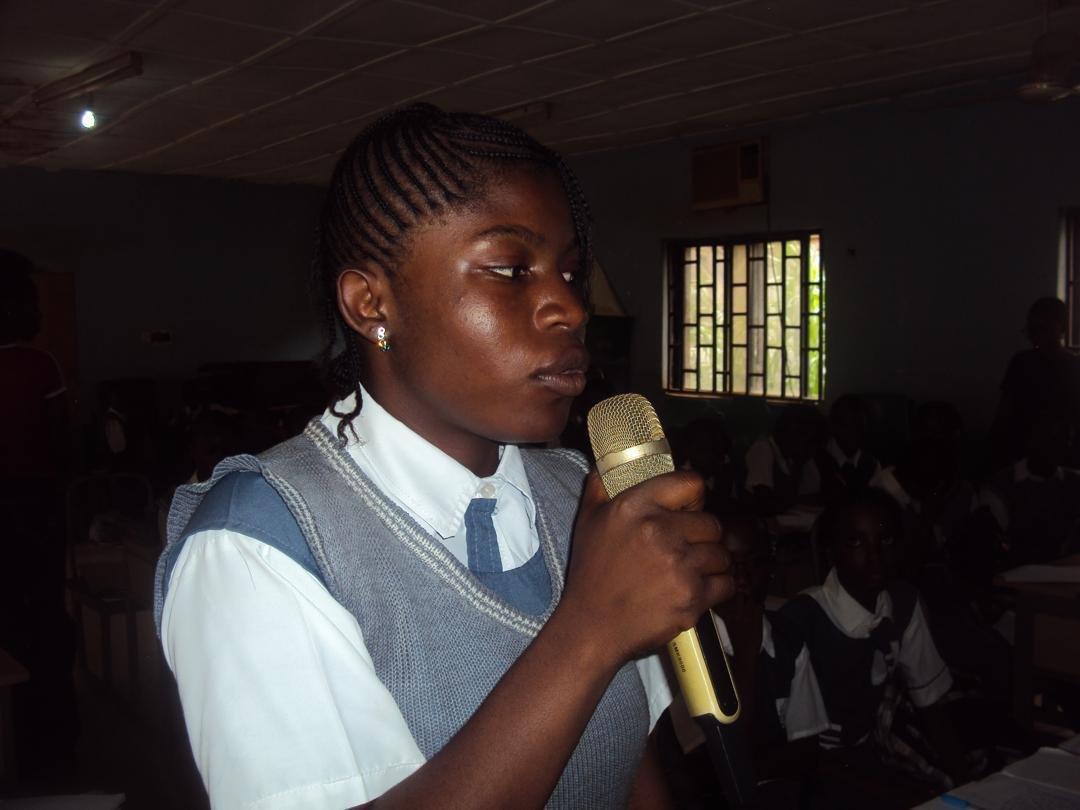
Every girl deserves the opportunity to learn, to live in safety and to shape her own future. Yet for millions of girls, the journey to adulthood remains marked by child marriage, gender-based violence, poverty and barriers to education.

The United Nations established the International Day of the Girl Child to recognise girls’ rights and the unique challenges they face. In 2026, the call to action is particularly important: ending child marriage and investing in girls’ rights must remain priorities for governments, communities and development partners.

UNICEF continues to highlight the consequences of child marriage for girls’ education, health and future opportunities. UNESCO advances the right to inclusive and equitable education, while the United Nations Population Fund (UNFPA) works to protect adolescent girls’ health, bodily autonomy and reproductive rights.

Girls and climate decisions

Beyond education and protection, girls must also have a voice in decisions about the environment and the future of their communities. Through the UNFCCC process, the Women and Gender Constituency advocates for gender-responsive climate action and the meaningful participation of women and girls in climate policy. In Nigeria, translating these commitments into reality requires sustained action by government institutions, schools, civil society, families and community leaders.

Our commitment

At SWEDIWorld, we believe girls are not merely beneficiaries of development. They are knowledge holders, innovators and active contributors to solutions for the challenges facing their communities. Through our work on girls’ education, menstrual dignity and climate justice, including the Girls’ Voices for Climate Just Futures initiative, we are creating space for adolescent girls to express their perspectives and contribute ideas about the futures they want.

Girls must be safe enough to learn, supported enough to thrive and heard enough to lead.

Ending child marriage, protecting girls’ rights and investing in their education and leadership cannot be achieved through a single campaign or organisation. It requires sustained commitment, adequate resources and collective action.

Lessons from the Green Climate Fund Regional Dialogue in Accra

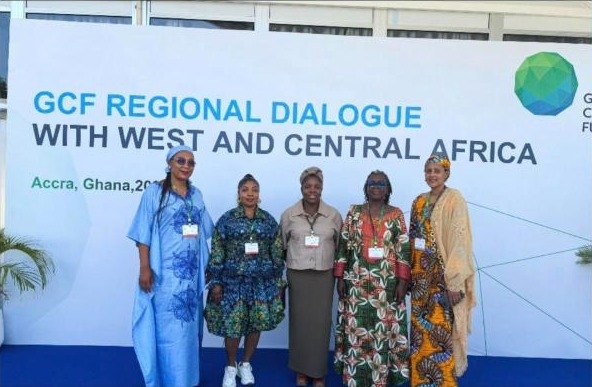
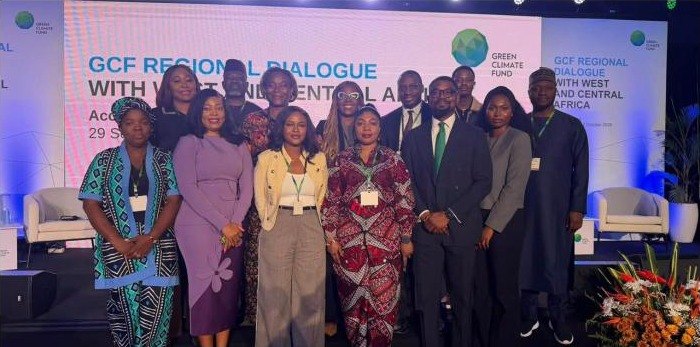
SWEDIWorld’s founder, Sewuese Asa, took part as a civil society observer in the Green Climate Fund (GCF) Regional Dialogue with West and Central Africa in Accra, Ghana, from 29 September to 2 October 2026.

The Nigerian delegation at the dialogue.

The Nigerian delegation included colleagues from the National Council on Climate Change, Nigeria’s National Designated Authority, the Federal Ministry of Finance, NIRSAL, the Development Bank of Nigeria, the Nigeria Sovereign Investment Authority, the Global Green Growth Institute and civil society. She also joined colleagues from the GCF Observer Network of Civil Society, Indigenous Peoples and Local Communities.

With colleagues from the GCF Observer Network of Civil Society, Indigenous Peoples and Local Communities.

A good idea is not automatically a good investment

In a project clinic, participants examined a proposed solar irrigation project for farmers. It sounded promising, but the questions went deeper: Is there enough water? What are the climate risks? What is the baseline? Is there a market? Can farmers repay the financing? What preparation is still needed? The exercise changed the way SWEDIWorld looks at projects: a good development idea is not automatically a good investment, and the solution cannot come before understanding the problem, the evidence and the barrier.

Keeping communities at the centre

Consultation is valuable, but civil society’s role should go beyond being consulted. SWEDIWorld will keep asking: Who is vulnerable? Where is the evidence? Who participated? Who benefits? Are women and local communities meaningfully included? Who is accountable? And what happens at the last mile?

The discussions on agriculture showed why attention must go beyond production to climate information, water, processing, post-harvest losses, markets and access to finance. Conversations on fragile and conflict-affected communities were a reminder that investments must respond to the realities in which people live.

These lessons will be carried into SWEDIWorld’s work with women smallholder farmers, community water security and resilience, and women and girls as agents of climate action.

She later wrote that the dialogue was “an important opportunity to engage with climate finance stakeholders, exchange perspectives, and strengthen connections around climate action”, and shared the GCF Africa Region Director’s reflections on country ownership and inclusive climate finance.

“Engaging in climate policy spaces while working directly with women, girls and grassroots communities has been one of the most rewarding parts of my journey,” she wrote afterwards, “reminding me that meaningful climate action must connect policy with the realities of the communities it is meant to serve.”

The Belém Roadmap: Women and Girls Explore Feminist Climate Action in Abuja

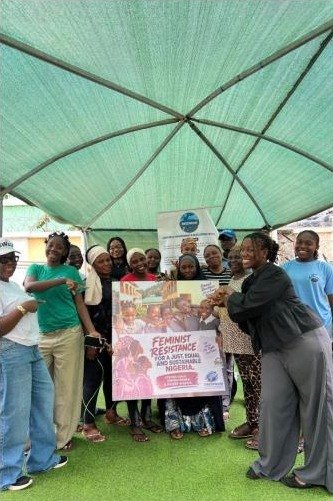
On 17 September 2026, SWEDIWorld, in collaboration with Community Links and Human Empowerment Initiative (CLHEI), brought women and adolescent girls together in Abuja as part of the Women and Gender Constituency Global Week of Action and Feminist Resistance Gatherings.

Women and adolescent girls at the gathering in Abuja.

The conversation

The discussion, “The Belém Roadmap: Exploring Feminist Climate Action”, asked a practical question: what does the Belém Gender Action Plan mean for women and girls at community level? For SWEDIWorld, acting on the Gender Action Plan begins with listening.

Women brought their lived experiences of climate change, livelihoods, farming, care responsibilities and inequality. Adolescent girls spoke about voice, rights and their wish to take part in decisions that shape their future.

What participation should mean

Together, participants reflected on what meaningful participation looks like:

Be Present → Be Heard → Be Considered → Have Influence

The gathering reminded everyone that grassroots knowledge is not simply a story to document. The Gender Action Plan provides a framework; the work now is to ensure its commitments reach communities and that women and girls are not only included in climate action but have a meaningful role in shaping it.

From feminist resistance to meaningful participation, we are committed to acting on the GAP. #ActOnTheBelemGAP

In the press

The gathering was reported by Daily Trust (“Groups Seek Greater Women, Girls’ Participation In Climate Action”) and Vanguard (“Women’s voice needs to be heard in climate decisions — SWEDIWorld”).

Nigeria’s Election to the UN CEDAW Committee: From Recognition to Action

Nigeria’s election to the United Nations Committee on the Elimination of Discrimination against Women (CEDAW), with 123 votes, is a significant milestone and a welcome recognition of the country’s role in advancing global conversations on women’s rights. SWEDIWorld congratulates the Government of Nigeria and the newly elected Committee member, and wishes her every success.

At SWEDIWorld, we believe this achievement should translate into stronger action for women and girls across Nigeria. It is an opportunity to accelerate progress on gender equality by ensuring that women and girls, particularly those in rural communities and other underserved areas, have equal access to:

  • education,
  • healthcare,
  • economic opportunities,
  • climate resilience, and
  • protection from all forms of discrimination and violence.

As a grassroots organisation working with women and girls, SWEDIWorld remains committed to supporting the implementation of Nigeria’s obligations under CEDAW through evidence-based advocacy, community engagement, girls’ leadership and partnerships that leave no one behind. It looks forward to working with government institutions, development partners, civil society organisations and communities to ensure that the rights guaranteed under CEDAW are reflected in the daily lives of every woman and girl in Nigeria.

Mentoring Women and Young People on Sustainable Food Production

Overview

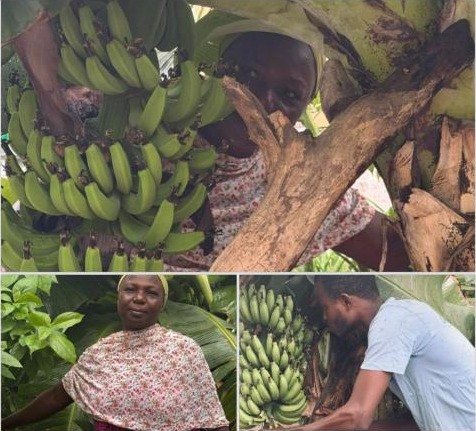
This World Environment Day, SWEDIWorld took its message beyond awareness and into the field. The organisation mentored women and young people on practical ways to strengthen food security through sustainable food production.

Banana and maize farming with women and young people.

What happened

The banana trees, maize fields and shared labour captured in these moments reflect more than harvests. They represent knowledge shared, resilience built and communities working together to secure their future. By promoting responsible land use and practical agricultural skills, SWEDIWorld is helping communities build resilience against hunger and the impacts of climate change.

Mentoring in the field.

“Food security begins with environmental stewardship, and mentoring communities today is an investment in a greener and more food-secure tomorrow. One lesson shared. One harvest at a time.”

Mentorship runs through SWEDIWorld’s work with women farmers: food security, the organisation says, “starts with knowledge”.

To support, partner with or learn more about this work, write to contact@swediworld.org.

Children’s Day and World Menstrual Hygiene Day 2026

Children’s Day: protecting every child

On Children’s Day, a family photo served as a reminder of the joy, innocence and promise every child deserves, and yet, SWEDIWorld noted, hearts remain heavy for the many Nigerian children whose daily reality is marked by fear and uncertainty instead of safety and celebration. The organisation called on professionals and leaders to strengthen their commitment to protecting every child and building a future where all can thrive without fear.

World Menstrual Hygiene Day: end the stigma

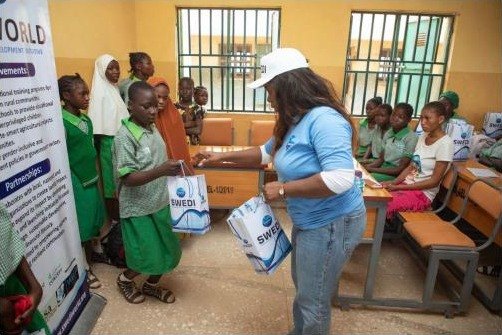
In Nigeria, countless girls still miss school, face stigma and lack basic menstrual products, silently losing dignity and education. Yet change is happening: menstrual hygiene kits are reaching schoolgirls through SWEDI Care, proving that a #PeriodFriendlyNigeria is possible. End the stigma. Period.

A SWEDIWorld team member hands out SWEDI Care kits to schoolgirls.

To support, partner with or learn more about this work, write to contact@swediworld.org.

From Soil to Strength: Twenty Women Turn Cassava into Garri in Usar, Benue State

Project at a glance

  • Location: Usar community, Kwande Local Government Area, Benue State
  • Participants: Twenty women farmers
  • Supported by: SWEDIWorld
  • Output: Eight bags of garri recorded in the first cycle; fifty bags of cassava flakes later reported ready to go

Overview

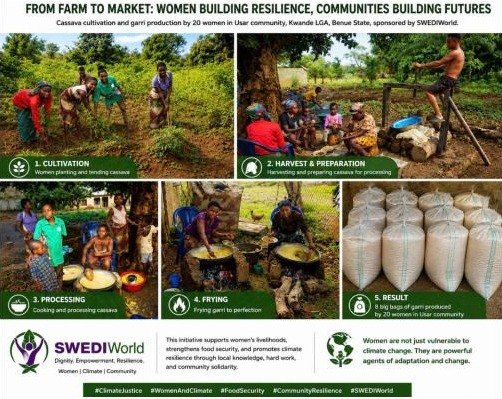
“Farmland is more than land. For many rural women and families, it is livelihood, food security, resilience and survival.” That is the reality behind this SWEDIWorld-supported project in Usar community, Kwande Local Government Area of Benue State, where twenty women carried out the full cassava value chain together.

What the women did

  1. Cultivation: planting and tending cassava on community farmland.
  2. Harvest and preparation: harvesting and preparing the cassava for processing.
  3. Processing: cooking and processing the cassava.
  4. Frying: frying the garri to perfection.
  5. Result: eight big bags of garri produced by the twenty women.
From farm to market: women building resilience, communities building futures.

Why it matters

The images document more than a harvest. They show the strength, cooperation and determination of rural women who contribute to household food security and local livelihoods while carrying the weight of climate vulnerability, food-system pressures and unpaid care work. At SWEDIWorld, we believe gender-responsive, locally grounded approaches are essential to community resilience: women at the grassroots are not only vulnerable to climate impacts, they are also central actors in adaptation, food security and community survival.

A follow-up update reported fifty bags of cassava flakes (garri) ready to go to market.

To support, partner with or learn more about this work, write to contact@swediworld.org.

Engaging the Global Climate and Sustainability Community in 2026

London Climate Action Week 2026

In May 2026 SWEDIWorld’s founder shared her plans to engage the growing global climate community around London Climate Action Week 2026. As Founder of SWEDIWorld in Nigeria, her interest lies in feminist climate justice, girls’ leadership, community resilience and locally led climate solutions from frontline communities, and in building meaningful collaborations and shared learning across the climate ecosystem.

Global African Women Sustainability Conference

At the Global African Women Sustainability Conference, the lesson was about purpose over spotlight: “Not every step on a red carpet is about spotlights; some are about purpose. The work we do, the people we meet, and the stories we carry all matter more than the stage.”

Our approach

SWEDIWorld helps women and girls become leaders in climate action. It builds the capacity of communities to respond to climate change and supports women and girls to tell their own climate stories and lead.

Gender Inclusion Is the Foundation of Resilient Food Systems

SWEDIWorld’s Executive Director attended the launch of Nigeria’s Revised National Gender Policy on Agrifood Systems Transformation (2025–2030), led by Senator Abubakar Kyari and the Federal Ministry of Agriculture and Food Security.

The message at the launch was clear: the time for implementation is now. The focus is shifting towards practical solutions: improving access to finance, strengthening cooperatives and creating opportunities for women and youth across the value chain.

“Gender inclusion is not a side note in agriculture; it is the foundation of resilient food systems. When women and smallholder farmers are fully empowered, agriculture does not just grow; communities thrive.”

The policy sits at the centre of SWEDIWorld’s work with women farmers in Benue, Nasarawa and the FCT, and of its advocacy for clear targets and funding to implement it (see the October 2026 report in Vanguard on making women farmers drivers of agricultural interventions).

Do you have questions? Call or visit us.

+234 803 328 2977

697 Idris Gidado, Wuye, Federal Capital Territory, Nigeria

contact@swediworld.org

Newsletter

Occasional updates on the work — a few a year, no more.

© 2026 SWEDIWorld — Safeworld Empowerment & Development Initiative. All rights reserved.

Site by Mbahar Solomon